Wu Kang | Radar System Specialist | Published September 2026
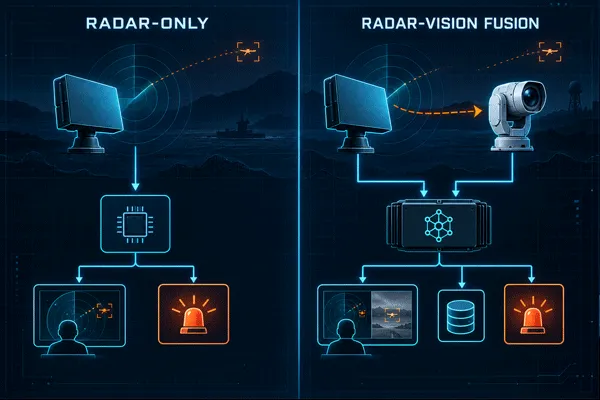
Perimeter security radar comes in two basic architectures: radar-only systems that output a track for a separate response, and radar-vision fusion systems that automatically slew a camera to confirm what the radar found. The right choice depends on perimeter length, site value, and how much of the confirmation work needs to happen without an operator.
Perimeter Security Radar Systems: Choosing the Right Fit
Two Ways to Build a Perimeter Radar Layer
A radar-only deployment puts a radar head — typically one of Midradar’s ground or low-altitude surveillance units — on a mast or tower and feeds its track output into an existing VMS or PSIM. Nothing physically slews toward the target automatically. Confirmation is either a human checking a nearby camera or a rule set that decides whether a track warrants dispatch.
A radar-vision fusion node does more of that work on the hardware itself. The radar, a visible-light or thermal camera, and a servo pan-tilt sit on the same platform, and the system automatically points the camera at whatever the radar just found. Midradar’s material for this category — what the company’s product literature calls the RDS series, or radar-vision fusion systems — describes it as combining radar detection with multi-spectrum camera verification and automated tracking, built for perimeter security, critical infrastructure, and border or coastal monitoring.
Neither approach is universally correct. They solve different parts of the same problem: one detects and leaves confirmation to something else, the other detects and confirms in the same box.
Radar-Only vs. Radar-Vision Fusion: Side by Side
| Параметр |
Radar-Only System |
Радарно-візуальна система злиття |
| Core output |
Track data — bearing, range, speed — into a VMS/PSIM |
Track data plus an automatically confirmed visual or thermal image of the same target |
| Target confirmation method |
Manual dispatch, or a separate camera system an operator checks |
Automatic slew-to-cue: the platform swings the EO payload to the radar bearing without operator action |
| Effective confirmation range |
Not applicable — no onboard camera |
Limited by the camera’s own recognition range, which is typically shorter than the radar’s detection range |
| Best-fit perimeter shape |
Long, low-density perimeters where per-kilometer hardware cost is the deciding factor |
Shorter runs or a handful of high-value nodes where fast, automatic confirmation matters more than raw coverage per dollar |
| Hardware per node |
Radar head only |
Radar head, EO/thermal camera, servo pan-tilt, and platform software |
| False-alarm handling |
Needs a separate rule set or a person to rule out clutter and wildlife |
The camera confirmation step filters a portion of false tracks before an operator sees them |
| Representative Midradar models |
MR-RDG and MR-RDA series radar heads |
MR-RD02SE-DMS15-AU Radar-EO Detection System; MR-AUS70-RD05-VC4075-TC61023 and MR-AUS20-RD03-VC4050-TC6410 |
The Confirmation Bottleneck Nobody Mentions
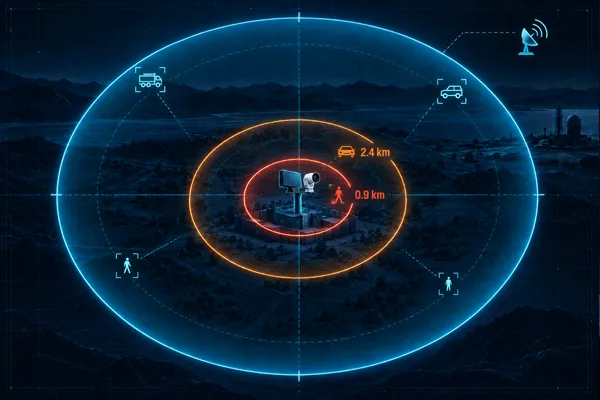
The assumption that fusion always beats radar-only breaks down once the camera’s own range enters the picture. Take the MR-HTVC6511-2132, one of Midradar’s multispectrum imaging cameras used in fusion nodes: it’s rated for human detection out to 3.4 km, but human recognition — the point where an operator can actually confirm what’s moving, not just that something is — drops to 900 m. A radar in the same system might be tracking a person at 5 km. The camera can’t confirm that target until it’s roughly a fifth of the way to the radar’s own detection limit.
That gap is the real design question in a fusion deployment: how many camera nodes does it take to keep confirmation range reasonably close to detection range across the whole perimeter? On a short, high-value segment, one or two nodes might cover it. On a long border run, closing that gap with cameras alone starts adding nodes faster than the radar coverage grows, which is exactly why long, low-density perimeters often stay radar-only with fusion reserved for specific points rather than the whole line.
Inside a Radar-Vision Fusion Node: MR-RD02SE-DMS15-AU
The MR-RD02SE-DMS15-AU is Midradar’s representative Radar-EO Detection System and the clearest published example of what a fusion node actually contains. It integrates radar detection, visible-light imaging, infrared thermal imaging, AI target recognition, and servo pan-tilt tracking, run through the RGS2000 platform for coordinated search, tracking, identification, alarm handling, and unattended multi-target monitoring.
The two other named models in this product line — MR-AUS70-RD05-VC4075-TC61023 and MR-AUS20-RD03-VC4050-TC6410 — are described the same way functionally (360-degree target search, tracking, identification, and platform monitoring), but Midradar’s category page doesn’t publish per-model distance figures for either one. Anyone specifying a project around those two model numbers should request the current datasheet directly rather than assume they match the MR-RD02SE-DMS15-AU’s published capabilities.
When Each Architecture Actually Wins
- Long border or coastline stretches where cost per kilometer drives the budget.A radar-only network covers more ground per dollar, with fusion nodes added only at the highest-priority points along the line.
- Critical infrastructure sites with a small number of high-value assets— substations, storage tanks, single gate points — where the cost of an unconfirmed false dispatch outweighs the cost of the extra camera and pan-tilt hardware at each node.
- Sites that already run a VMS or PSIM and just need a detection layer added.Radar-only output feeds in through standard protocols without paying for a second platform running alongside the existing one.
- Projects where operator headcount, not budget, is the real constraint.Automatic slew-to-cue removes the step where someone has to manually swing a separate camera toward every alarm, which matters more once a site has more radar nodes than people watching them.
Getting the Two Systems to Talk to Everything Else
Both architectures need to connect to whatever a site is already running, and that’s mostly a protocol question rather than a radar-performance question. Midradar’s platforms support GB/T 28181, ONVIF, and RTSP for connecting to third-party video management or command-and-control systems, plus RESTful APIs and SDKs for closer integration work. A radar-only deployment typically needs this to feed tracks into an existing VMS; a fusion node needs it to push confirmed video and alarm events out to a command center that isn’t the bundled RGS2000 platform. Either way, checking this list against the site’s existing system is worth doing during the RFP stage, not after equipment is on order.
Perimeter Security Radar Systems: Choosing the Right Fit
What Integrators Run Into During Installation
Fusion systems carry a calibration step that radar-only systems don’t. The camera’s pan-tilt zero position has to be mechanically aligned with the radar’s boresight, or slew-to-cue arrives near the target instead of on it — a problem that shows up more at the edges of the radar’s field of view than at its center, and one that’s easy to underestimate during a proposal and expensive to fix after mounting.
Cost is the other variable that’s straightforward in principle and hard to pin down in practice: Midradar doesn’t publish pricing for either architecture, so per-node cost comparisons have to come from a project quote rather than a published price list. What is consistent is the hardware delta — a fusion node adds a camera, a pan-tilt unit, and platform licensing on top of the radar itself, while a radar-only node doesn’t.
Поширені запитання
Is radar-vision fusion always better than a radar-only setup?
Not for every perimeter. Fusion adds automatic confirmation, but confirmation range is capped by the camera, not the radar, so very long perimeters can outgrow what a reasonable number of fusion nodes can cover.
How much more does a fusion system cost than a radar-only system?
Midradar doesn't publish pricing for either architecture. The hardware delta is a camera, a pan-tilt unit, and platform licensing per node; the actual cost comparison needs a project quote.
Can cameras be added to an existing radar-only deployment later?
The radar and camera hardware are separate components in principle, but doing this after the fact means solving the same radar-to-camera boresight calibration that a purpose-built fusion node handles from installation.
What protocols do these systems use to connect to an existing VMS or command center?
GB/T 28181, ONVIF, and RTSP for video/command integration, with RESTful APIs and SDKs available for deeper custom integration work.
Do the MR-AUS70-RD05-VC4075-TC61023 and MR-AUS20-RD03-VC4050-TC6410 match the MR-RD02SE-DMS15-AU's detection range?
Not confirmed either way — Midradar's category page doesn't publish per-model distance figures for those two models, so a project spec built around them needs a direct datasheet request.


 13:37
13:37